Showing posts with label Twenty20. Show all posts

Monday, June 24, 2013

The Great Indian Team Performance Curve: A Thesis

I read a friend’s Facebook status post, wondering about the changes we are witnessing  in the Indian team’s performance. To be precise, his questions were “how so much” and “how so quickly”.

A while ago, I had read an extremely well-conceived article by Cricinfo’s Siddharth Monga on the contribution of the “system” to India’s Champion’s Trophy win last night. Here it is.
Armed with the thoughts that came while reading Monga’s thoughtful piece, I set about trying to construct a quickfire “thesis” to explain the path charted by the Indian cricket team

Part A: how so much?

Ans: The direction that a cricket team – correction, an Indian cricket team goes can be largely explained by measuring the following areas:

(A)   the leadup to selecting the final 15 who set off for the tour – including resourcefulness, non-compromise and vision,
(B)   Captain’s performance as a player
(C)   The captain-coach duo and their (interpersonal) vibes within the team including handling of individual players as well as coaching staff,
(D)   Form of individual stars in the team, if any; and
(E)    Expectations set by the leadership team from the players, series by series (completely on-field stuff, nothing interpersonal here). This includes flexible thinking.

[A, B & D are extremely version specific; hence same set of people can produce different performance curves in different versions of cricket]

  • Ganguly's team, in rebuilding phase of 2000-2003, thrived partly on A & B,  a lot on C & D and little less on E (except uncompromising integrity).


  • During the latter parts of Ganguly era (late 2004-2005) the team form dipped due to partial dips in B, C & D.


  • In Dravid’s (2005-mid 2007) era the emphasis on A & E became supreme; B was very good too, for most parts. However all of that was completely undone by the then coach Chappell's effect in undermining C - so much so that the huge minus in B led to underperformance in D as well.


  • MSD's 1st era (2007--2010), on the other hand, revived team form almost entirely based on C, D & E. In Tests, B almost did not come into picture, such was the overwhelming effect of D [Big four + Viru + Zaheer]!! A got toned down to moderate – which is fine if D is good.


  • Dhoni’s 2nd era (early 2011 to end 2012) saw a virtual disappearance of D, while B did not come up to compensate. This made BIG difference, even as A & E remained very similar and C dipped only marginally compared to Dhoni’s 1st era. [Not by coincidence, Era-2 was the first days for captain with new coach]


  • Dhoni’s 3rd era is just starting. D is not likely to reach the stratospheric heights of his 1st era anytime soon (certainly not in Tests). I agree majorly to this article. By accident or by design, Team India's A has shot up in past 3 months, even compensating for seniors' exodus contributing to instability in D (it is also looking up, thanks to performing youngsters).  In fact, A has fared so well that D (at least in Champion’s Trophy) was a factor of A!!   Decisive A has also led to decisiveness in E. Factor C, while still very good, is now so very different from Era 1. These days we see an animated Dhoni who actually tells youngsters what to do…and I believe he is now in sync with India's "new" coach Duncan Fletcher.


Part B: how so quickly?

A & E are the only components that are largely controlled by intent rather than chance. While teams thrive or perish on ‘culture changes’ in either direction it is foregone that culture changes take a lot of time.

A & E can be implemented in a very short time-frame. It is only the start, though. Any major changes in A & E, implemented too quickly, might create a shock-wave in ‘good’ (read ‘comfortable’) times, leading to adverse impact on results. However in THIS case, major changes in A & E were done when the team performance was close to its nadir (i.e. around when Dhoni’s 2nd era was closing out). Things that would seem to be “upsetting” otherwise...those were perhaps now seen as a “Ray of Hope”.

Everything, absolutely EVERYTHING can happen when people chuck out the resistance and look forward to a change.

That ends my thesis, responding to Shrikant Subramanian’s Facebook question. [wiping brow]

Exciting? Indeed. I was just as excited while force-fitting the pieces of the puzzle. Thanks to you for appreciating. And at this humbling moment of success I would like to thank my…zz-zz-zz-zz

Crappy?? Yippie kay yay…..all theses necessarily are.


Thursday, May 23, 2013

IPL-6: Moment of the tournament

THE MOMENT of IPL-6 just came up in today's Eliminator between Rajasthan Royals and Sunrisers Hyderabad in the Delhi play-offs.
38 yr old "foreign" Brad Hodge finds a little time to use between deliveries of this knock-out match, and walks up to a forever-amused-looking "local" wonderkid (Samson) - less than half Hodge's age - to teach the latter a chapter from the book of stealing singles. 
"Don't hit it boy, work it and get that crucial extra run." The old man gestures, but only after having demonstrated it. 


Priceless. 
Almost justifies the existence of IPL...such moments.

Monday, May 06, 2013

IPL-6, Rajasthan Royals, Uttar-Dravid, Sanju...and Uttar-Process

"Manzilein unki hoti hai jinki sapnon mein jaan hoti hai
Kyonki pankhon se nahi, hauslon se udaan hoti hai"

Sidhu goes overboard to describe Dravid's achievements as player and skipper this IPL season, coming back from "packing sandwiches for kids" to powering his team towards a high scoring chase tonight against Pune Warriors.

Gavaskar had a more unique line of tribute, from a Mumbaikar to Bangalorean:
"These guys from Bangalore are underrated - they are such nice guys who achieve but have no self-promotion."

But beyond this Rahul celebration (which is every bit deserved for the old man) a little story may be emerging in Rajasthan Royals backyard for Indian cricket fans. We may be hitting upon the next big thing in batting. I can't believe a batsman, even an 18 year old in-form talent, can strike a first ball cover driven four of THAT class. This was the first I saw of Sanju Samson - and I am already hoping for more, much more.

Since he is 18, he is also the right person at the right place at the right time: playing for RR just when the team is buying Rahul's "horses for courses" theory, backed by the vision of "get the processes right and worry not of the results"....something that he developed with Chappell as his vision for 2007 world cup but could not sell to the Indian team due to "over-aggressive selling" tactics of his then coach.

This RR team, quite like RR of 1st IPL season, seems to be working to "process is king" theory this year. It shows in the lack of tension on the faces of the players. May or may not be the best / only way to win, but the journey sure becomes more enjoyable. Imran Khan used to speak of it during the later, more successful phase of his career - but can't even compare a modest team lke RR to the men Imran had at his disposal. So THIS really is the first case study of the "process + Horses for courses" theory in a sub-continent setup.


PS: In that 2005 article which predicted that Chappell-Dravid will be adopting this "horses for courses" theory in 2007 WC instead of set teams and batting orders, I had given almost all credit to Greg Chappell for the theory. But subsequent to that article, Chappell's way of handling shows that he was only the father of the idea. It is Dravid who, inspite of then failure of the concept, kept believing in it and now the man has found a perfect platform to try it out amidst a sea of youngsters. This time these guys do not have conflicting signs to confuse them as there is no Chappell around.

Tuesday, October 09, 2012

The circle of a day

In the morning this daily quote flashed up on my office desktop as I booted up the comp:


“Nothing in the world can take the place of persistence. Talent will not; nothing is more common than unsuccessful men with talent. Genius will not; unrewarded genius is almost a proverb. Education will not; the world is full of educated derelicts. Persistence and determination are omnipotent. The slogan ‘press on’ has solved and always will solve the problems of the human race.” – Calvin Coolidge


12 hours later I was preparing to shut it off.
I checked gmail and, as I was about to log off, I found a link on Virat Kohli's phenomenal rise.
I am pasting an extract from the article:

"His work ethic is brilliant, his focus is immense," says Yuvraj Singh. "Since the time he has joined the Indian team, I saw his work ethic and wished and wondered why I didn't have that work ethic when I was his age."


I reckon Yuvraj and Rohit are even more talented than Virat.They always were.
At the end of the day, my working day, Virat is pipping those two at what Calvin Coolidge quoted to me when I started the day.
Good night, folks!!

Saturday, April 23, 2011

Match winner

The customary glance from dinner table at IPL scores on SetMax told me Delhi had set an incredible 230 to Kings XI Punjab..Without looking at the scoreboard, it appears Sehwag has fired. Punjab were decently placed in the chase at 100 odd for 2 in 10 overs but even so the ask looks improbable to achieve.


But then the camera pans to a Delhi Daredevils bowler who was released from 3 years of service to KKR. I could almost hear the entire lot of IPL followers in Punjab whisper in nervous anticipation:


"Hey, this match is far from over!"
Ajit Agarkar, though, was quite oblivious of the hopes he continues to produce in rival camps.


Update: Ajit dearest comes on to bowl 17th over with Punjab needing 72 off last 4 overs. Gives away 15 runs in that over. Agarkaresque if viewed from a distance, it really is decent fare going by the match proceedings.

[developed from a note on my Facebook page]

Thursday, April 14, 2011

Is Ishant's 'nishant' round the corner?

I was passing via drawing-n-dining room** when I glanced at the TV screen. An IPL match was on, as you would expect this time of the year barring Richter 9. At that point of time they were showing a replay of Deccan Chargers' Ishant Sharma dismissing RCB's Dilshan caught behind with a good quick ball.At that point of time they were showing a replay of Deccan Chargers' Ishant Sharma dismissing RCB's Dilshan caught behind with a good quick ball.


I came back in few minutes and sat down to watch Ishant bowl the 6th over of RCB innings. He was fast and accurate..and he was hurrying a batsman I have not seen get hurried in quite sometime, the splendid AB de Villiers.


Ishant clocked 149kph & 150kph in 2 deliveries. Gony's decently-fast-medium deliveries were clocking 133 odd in overs on either side of Ishant's over. The speed guns did not look to be malfunctioning, certainly not by much.


Instantly I remembered the lankier Ishant, all of 19 years, bowling at 140+ for 12 overs to Ponting at Perth in Jan'08 to prise him out and decide the Test. Then I also remembered the underperforming Ishant that struggled to clock mid-130's or get any accuracy / movement since 2007-08 Australia tour (more specifically, since Ishant started his 1st IPL season in Apr'08 - I won't name the team to avoid controversy;-).


Is the tide turning and the speed returning for Ishant Sharma? I loved rediscovering that Ishant can still produce that pace-bounce-length combo that worked for him in his 1st 4-5 months irrespective of pitch & weather. Setting aside his recent performances, Ishant is our main hope to carry the future Test pace attack. He is the only one since Javagal Srinath who can be a genuine quickie in his best days which, I am sure, are yet to come.


I hope he took the World Cup exclusion as badly and as personally as those speed guns showed today.


**take the hint, mate - I was NOT in front of TV..if IPL was to be 'corruption', I would be 'Anna bhau' remember?


Earlier posts on Ishant Sharma & his bowling: here and here


Update: It appears Ishant continued producing high bowling speeds in the 8th over (his 4th). Here is an excerpt from cricinfo commentary:


7.3


Sharma to Kohli, 1 run, bouncer, hit in the air and falls safe in the mid-wicket region. Ashutosh comments on the speed Sharma is bowling, "Has any one bothered to notice the speed at which Ishant Sharma is bowling, his fastest is at 152.2Kmph and he's averaging at almost 150kmph."

Wednesday, October 07, 2009

Spirited cricket

NDTV were interviewing Lalit Modi and Ravi Shastri on the exciting prospects of Champions' League T20. Rahul Dravid joined in the interview. Though ke kept looking like a fish out of water in the interview aimed at exhorting the newest thing in cricket's entertainment avatar, Rahul came up with the two best quotes of the session.

Rahul reflected back on the way his T2o team Bangalore Royal Challengers (BRC) had come back from being down and out at half way stage to reaching the IPL2 finals. Lalit Modi took this opportunity to pay compliments to Rahul's cricketing abilities in his self-styled vocabulary, mentioning that Bangalore Royal Challengers were such a bad shape at half way stage only because Rahul was away at the time 'having a baby'.

Rahul is good at hiding his spontaneous expressions. We know that from his countless post-defeat press conferences as Indian captain. We could not trace if he pulled back a chuckle at Modi's words but he certainly returned a good line of his own: "Some things are more important than cricket."

A while later, the interviewer asked Rahul about his team owner, liquor baron Dr. Vijay Mallya. There is a background to that question. Ugly incidents followed the bad show of BRC in the inaugural IPL, eventually leading to sacking of Rahul as skipper in IPL2. Rahul again managed to hold back and yet not sound boring. He said a few words which went like: "He wants us to play in the right spirit. Spirit is the key word here."

One of these days, Royal Challengers may just happen to collect the maximum points for gentlemanly conduct on the field in some T20 tourney. That won't be surprising at all with Anil Kumble as the team skipper. As a result we may actually find Dr. Mallya accepting the spirit of cricket award at an ICC awards function.

Far from the dais and away from his candle-lit table at the awards nite, the first BRC skipper would be guffawing away uninhibitedly in front of a wash room mirror even if he might have won nothing.

Saturday, June 27, 2009

And Afridi now....

Do Michael Jeh and me have a common hub to our "cricket thought processes" somewhere? The next post after Dhoni that I was (not surprisingly) unable to put up on Pavilion View after Pakistan's T20 triumph last week was (not surprisingly again) on Afridi.

But here is Mr Jeh, blogging on Afridi on Different Strokes and urging the maverick Pak all-rounder to utilise the rest of his cricketing days better. Much like I urged Shoaib to use his post-30 cricket career wisely 3½ years back [on an earlier incarnation of the same forum that Michael now blogs in]. I sincerely hope that Michael's hopes don't get dashed.

My thoughts on Afridi are a little different from Michael's though. When I remember and try to list out cricketers who were born for T20, Shahid is one of 4 people that invariably come to mind. If there are Gods of T20 up there, I believe they would not like Afridi to retire before making a mark on their game. As soon as Afridi held up his bat in victory after the winning shot was made in the 2009 T20 final, I remembered another man who came back many years after writing himself off everyone's minds to win the trophy that destiny surely wanted to be his. It was in another sport.

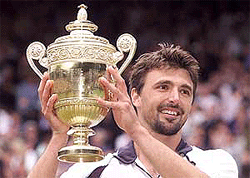
Goran Ivanevic lost 3 Wimbledon finals in his 20's. Out of sight, out of mind and playing on a wild card, he fought dipping game and advancing age more than his opponents over a fortnight on London grass a few years later and roared into the finals of Wimbledon. That evening he held the emotions of a whole generation of tennis lovers across the world under siege for a few unforgettable hours. He won - and we know he was not the only one in the world who cried at that moment. Empathy and love. That's what you earn when you play your game from your heart and more than make up for the tantrums you throw by overruling umpires at times to rule line calls against yourself.

Great memories are often accompanied by better memories. Goran had an opponent who displayed the essence of sport by throwing in everything he had during the game to try and beat the Child of Destiny, yet showed genuine appreciation of Goran's emotions in his own defeat that meant he would never hold the Wimbledon crown aloft like Goran.

Patrick Rafter, I am your fan forever.

PS: I forgot to name the other 3 guys that were surely born for Twenty20. Shoaib Akhtar, Billy Bowden and Romesh Kaluwitharana. I must have blogged on them sometime, somewhere.

Update: Yes I did. On this very blog. Am I losing memory quicker than Sanjay Singhania? Damn.

Update 2: The other thought I had - this one similar to Michael - as Afridi played his innings in the T20 World Cup final was: This man repeatedly and unrepentently bats in full length international cricket matches as others would in the last over of a 5-over friendly. He does that in Tests and in 50-over games alike. But here he was 'anchoring a chase' in a Twenty20 by remaining unbeaten till the end! Someone brought the horse to the water 13 years ago - and NOW it is finally drinking!

'Make-shift' post on Dhoni

Since India's ouster from T20 World Cup I was planning to put up a post on Dhoni. It never materialised.
I thank Michael Jeh (Different Strokes, cricinfo) for allowing me to make up somewhat for that non-post. He has written a fine post on Dhoni at 'Different Strokes' where he discusses much the same issues I had in mind.

I am referring you to that post, on the rather flimsy ground that I made a comment on it.
Sorry for that, folks. I truly am off blogging these days. Worse, I cannot even put a date on when (or if) I will be back to full-time blogging.

Sunday, May 24, 2009

Spinners were more successful in SA's IPL-2009 than the Indian IPL of 2008

What was it that allowed that to happen?

Was it the extra bounce? Perhaps it was. The extra rise was clearly worked to the advantage by all the top spinners including Kumble, Ojha, Warne, Vettori, Harbhajan and Muralitharan.

Also, was it the extra 10 or so yards from the batting crease to the boundary ropes? I remember Ian Chappell expressing frustration last year at the bats getting better and the fields getting shorter at the same time. His argument was that by allowing this to happen the cricket administrators were looking for short sighted satiation of the spectators for more sixes (for that is what the administrators can think of as the only love of us one-dmensional cricket fans). The short boundaries were making the spinners lose the inclination to flight deliveries as even the mishits created by good bowling from spinners to top batsmen would regularly go over the fence instead of becoming a catch in the deep. At least the 75-80 yard boundaries in South Africa give tweakers some extra 'ground'.

But someone will need to explain to me where the turn came from. Since their return from exile in the 90's, the SA cricket team were as notorious for their lack of spinners as the pitches in their country were renowned for not supporting them. However spectators got to see some sharp turn in some matches with 6-7 over old balls. And they got that not only from the best spin doctors but also from some of the lesser known (but adequately effective) practitioners of spin bowling.

Did the IPL supremo Lalit Modi manage the impossible of not only taking the tournament from Asia to Africa but also some of the original Indian 'pitch' and tenor within a one month timeframe?

Can't rule that one out, going by the way Modi is beginning to rate himself as a 1st class miracle worker and trying to conjure up bigger challenges for himself.


Arranging 2 IPL's a year, for example!!

Asking rates above 10 for more than 5 overs are difficult to get even in T20....

....no matter who you have at the crease during those overs with whatever number of wickets in hand.

Need proof?

Have a look at this chart for the IPL season 2 stats showcasing best strike rates amongst batsmen.

The list may well get new additions after the 2nd semi final and the final, but as on 23rd May morning there are only a handful of people who could twice achieve a strike rate of 200 or more (i.e. 2 runs a ball, or 12 runs per 6 balls) in the completed innings they played over 14 or more matches.

They are the usual suspects - Ross Taylor, Adam Gilchrist and Yusuf Pathan. What's more creditable, they have achieved these strike rates when it has mattered most - in the 2nd innings(if I am not mistaken then all of these 6 specials barring one Y Pathan innings were done chasing down a total - or is it 100%?? Hope someone answers that). This shows how good they have been in cracking the opposition team's bowling strategies.

But ultimately this list also shows that even these 3 whirlwinders were THIS good in only a couple of matches in such a long series. And that some other not-too-less special guys like Virender Sehwag, Yuvraj Singh, MSD, Raina, ABdV - for all their fireworks - could either not achieve a completed innings with 200 strike rate or managed to get there just once. In other words, these 2-runs-a-ball-and-more innings were not as common as we may presume they were if these stats were not presented to us.

Say one of these top 3 guys (Pathan / Taylor/ Gilly) were chasing 10 an over and also playing one of these special innings. A simple calculation will show that they would still be required to either take risky singles to hog the strike or need their partners to also score at 7 or 8 to get over the line. In the closing overs it is quite likely that the partner will be a newcomer at the crease. That complicates things further.


And that, eventually, gives us an idea why it can be rather difficult to chase 10 plus in closing overs even with wickets in hand.


Knockouts are the phase where this pressure of asking rate will be felt even more in the 2nd innings. Why 10, anything above 8 can prove to be too much pressure in the final 5 overs of a semi final or the final. Now watch the replay of Gilly's innings yesterday and rate it in perspective. In a semi final clash and chasing a not too modest target, he scored at 3 runs a ball for the first 17 balls and at 2 runs a ball for the next 17 before getting out in the 35th delivery he faced.

How do I rate it? Even leaving alone the premium quality hitting demonstrated by the ageless gladiator from the Aussie Juggernaut of the 2000's, I consider Gilly's 85 yesterday to be the best of all above-50 IPL 2009 innings in terms of significance, and is arguably also the overall best amongst all knocks played in the 2 editions of IPL we have seen so far.

[Closest contestant in overall category: Warnie's cool headed finish in IPL 2008 final. Warnie scored just 9 runs, but then it was special not for the volume but for the sheer weight of the situation he was in].

Saturday, May 23, 2009

"Good captains need to be fiery and pumped up on the field"

Do you believe in that?? Then perhaps you can't even picture the man I will talk about now as a remotely good one.

Look at
this!!

We remember Shaun Pollock the captain as the guy that allowed his team to get knocked out of the 2003 world cup by miscalculating the rain shortened target by 1 run....But he is the 3rd most successful captain after Ponting and Jardine in the history of Test cricket. And that record spans over not 3 or four but 10 series which he captained (unlike most of the other guys in the top 10 list).

I think whoever pushed him out of Test captaincy (or did not think to coerce him to continue in tests after he stepped down after 2003 WC) pushed SA team back by a few years and allowed SA cricket to pay a price costlier than that 1 run.

I still remember the 3 match ODI series in
April-May 2000. Steve's not-almighty-but-already-mighty Aussies landed in SA to play the series that was scheduled about 7 days after what turned out to be Cronje's ouster from cricket.

It was in such a scenario that Shaun Pollock took up the South African captaincy - and SA almost surreally won that series in spite of all that chaos leading up to the series. Fluke? I guess not. Aussies played well and still came out 2nd best. Later in September the same year we saw the Aussies taking SA on in the new 'covered' stadium in another
3 match ‘away’ series. Polly's Springboks lost the first match badly. However they came back and TIED the 2nd one before winning the last one.

He was perhaps the one international captain in the 2000’s who never got his due as a galvaniser of cricketers into a unit stronger than the sum of its parts. [I am not talking about Warnie / Gilly and such like that did not get the opportunity; that will be a whole new discussion and the topic of some future post of mine]. If you look back at the particular phase in last year's IPL when MI started to turn around (only to botch it up in the last 2 matches and miss the semis berth) you will notice that the fightback happened just as Polly replaced Bhajji, stand-in captain for the first few matches till the ban was 'slapped' on him. It happened even as their best player and captain Sachin Tendulkar was nursing injuries on the sidelines. One can almost say (at the risk of insulting Tendulkar’s leadership capabilities) that the finishing touches never happened because Sachin Tendulkar happened to be back after the injury and took back the leadership for those crucial last league matches!

The above stats and recollections, strrewn together, suggest that the taciturn man we saw on the field was as good a leader in ODI's and T20 as he used to be in Tests. He was not quite the commentators' / adman's delight like some skippers from the subcontinent during his time but he was no less effective than his boisterous counterparts, to say the least.

Pollock has opted out of travelling to India for the IPL and in all likelihood he will not be back in next year’s edition of the IPL. But if he decides to have a rethink, don't you think my home team Kolkata Knight Riders needs someone like him at the helm?

Monday, June 02, 2008

The quintessential T20 folk

Since the T20 world cup last year I have been trying to make my mind up on the one cricket personality who is / was literally 'born for T20'.
Repeatedly the name that keeps coming back ahead of the Jayasuriyas, Gambhirs and Misbahs is Billy Bowden.

This umpire is the Bradman of flamboyance (almost as essential to the entertainment aspect of Twenty20 as run making, wicket taking and direct hits are to its cricketing aspect) in an era where no player is so distinctly ahead of competition on any one area.


Billy continued to hit other potential competitors for "double crooked finger six-phase hop" sixes till I came across a league match involving Jaipur's Rajasthan Royals last month. A little right handed batsman opened the batting for them. Swapnil Asnodkar is armed with quick reflexes and a few decent cricketing shots but no one quite knows how he would choose to use them. The only certainty was he would surely use his shots at the rate of one per ball. (Why? He wasn't allowed any more.) He could fall any moment. At the same time he could hit any bowler anywhere irrespective of the game situation. It was like watching a gunfight in an old western.

Now we have seen that earlier. To be more descriptive, we have seen another right handed opening batsman do that on a regular basis through a tournament or a season. Of course sometimes Jayasuriya bats like that when in blazing form but not always. But Jayasuriya is also entwined with this deja vu. Because it was the guy who started off alongside Sanath on the latter's journey to ODI glory in the tri-series against Australia in 1995-96, a series that built up to that frenzied Sri Lankan world cup win of 1996. Romesh Kaluwitharana. He must be as truly born for T20 as is Billy Bowden.

Kaluwitharana fell by the wayside in later years but he will never be forgotten by cricket lovers. Since the late 80's one dayers were never more watchable than in the Kalu-Jaya era (not just because these two belted leather but because their innings could also be over in the space of a few balls as in the Kolkata WC semi final). Apart from Jayasuriya to an extent, no one opening the innings consistently in any form of the game (not even in T20) has perhaps attached as little value to his wicket as the pocket-size Sri Lankan wicketkeeper did in the period 1995 - 1997.

Kalu did it for his team (Sri Lanka) just like Swapnil did for Rajasthan Royals in the inaugural edition of IPL. Only Kalu must have been more compelling as he batted like a suicide bomber match after match in one dayers, in innings played over 50 overs where each top order player can expect to get 40 balls per innings on an average to construct his innings instead of 15 (as in T20). But whenever Sri Lanka batted we saw a man who would have no second thoughts on giving up his right to build an innings in international matches so that the team total could be boosted by an extra 15 or 20 runs. Perhaps Kalu payed with his career when the Sri Lankan team stopped doing well post 1997, but he never went back on playing the self-sacrificing role allotted to him by his captain.

Sad that T20 cricket came a little too late for the guy who was born to play it. The other day I harked back on the thrilling Indo-Pak quarter final played of the 1996 world Cup. It was the 9th of March. Now I intend to recall a little memory from earlier in the same day. This bit is from the 1st quarter final between Sri Lanka and England (this one was a day affair unlike the Indo-Pak one). It was the exact opposite of a 'thrilling' affair. England set an ordinary target and were steamrolled by Jayasuriya in the run chase. I had returned home in the afternoon a little late. I already knew Sri Lanka had just begun their chase and switched on the telly. The first picture I saw was 'Little Kalu' (as Tony Greig and millions others love to call him) walking back to the pavilion. The batsman's score appeared on the screen:


Never saw that match or its highlights again but since that point of time I was sure that the 1st two balls were 2 fours. Mathematically it could have been a six and a two. [5 + 3 was possible but highly unlikely]. But somehow a 'two' did not fit well with the figure 8(3) there. It must be 2 fours followed by a dismissal, someone within me reasoned. I got the confirmation many years later from the cricinfo scorecard for that match that someone was right.
That innings of 8, in my mind, remains the quitessential T20 innings. I care a fig if it was played in another format.
Having played a number of similar innings in a short period, Kalu must rank alongside Billy Bowden as the 'Born for T20' tag.
PS: Just after writing that post I find cricinfo have already done a piece on Swapnil's Kalu resemblance. No mention of the 8 though!

Saturday, May 31, 2008

T20 slowly but surely spreads its tentacles...

"Pakistan have to score 2 runs off the last ball to qualify. Indian quickie Samit Dravid charges in and delivers the ball....it's a good yorker and goes straight through big hitting Suleiman Khan to keeper Aryan Khan. The batsmen run desperately to force a bowl out but the Pakistan dream ends as Aryan hits the stumps. India were already out of the main event and now in their final qualifying match they have shut their arch rivals out of the 2031 T20 world Cup at Italy.

These are strange scenes. Both teams look gloomy after the match. This is the 2nd consecutive time that no sub continent team other than Sri Lanka has qualified amongst the final 32 for the world Cup. It is so tragic for the millions of cricket loving people in these two countries that even the presence of big ATL* stars like Suleiman, Samit and Arjun Tendulkar could not help them break the jinx. Another two years of painful wait has already begun..."

A futuristic bad dream? Not really....

Some things like Indo-Pak rivalry will never change but the famous sub-continent needle has every possibility of decaying into a clash of the minnows in another two decades if Twenty20 has its tentacled way across the global marke and if subcontinent cricketers are not smart enough to keep pace.

I can hear a few curses for the sad ending at the qualifiers there. Come on, it can happen in ball games with 32 teams playing in the showpiece event. Take the following piece of information as a message of hope: France failed to qualify for two world cups (1990 and 1994) but then won the next one at home. Of course, that was in soccer which would be ranked second after cricket as a global sport in 1930.

So we can still expect India to win the 2033 T20 world cup at Tibet (T20 world cups come every two years). Perhaps they will manage to overcome pre-tournament odds even higher than 66-1. That would be a nice way to celebrate 50 years completion of
Indian cricket's first world cup win.

* ATL is American T20 League

Sunday, May 25, 2008

Goodbye Kolkata Knight Riders

As I watched the Kolkata Knight Riders' thrilling run chase at the Eden Gardens in their last league match against Kings' XI Punjab draw to a favourable end for my home team tonight, two thoughts filled my mind:

1) You can make memorable matches out of brilliant lone hand displays like Ganguly & Gul did in this match, but you need supporting contributions and boring team efforts to do well over a period / tournament. In addition to the captain you need more members to stick out their head and show willingness to last the distance. So often the main batting strikers in this line up - Ganguly himself as well as Hussey - were busy doing the menial job of trying to stabilise the ship because the others in that role were not staying put. This cost the KKR boys a few matches.

Inspite of the win KKR bowed out of the competition today as they could not manage enough wins to get themselves a semis berth. I tried to figure out the differences of Ganguly's 1st IPL series for KKR from Ganguly's admirable Test captaincy career with India. One was obviously that this was only the 1st season and the skipper himself took some time to get accustomed. I am sure the second season will be better. The other difference was the one discussed earlier - not having foundation laying folk in batting and bowling.

Coming to think of it, Ganguly's memorable stint as India's most successful Test captain at home & away could have been a lot like his 1st IPL season of the Knight Riders had there been no indefatigable Rahul Dravid at one end (at a batting average of 80+) while batting and no Kumble to keep up one end all day in the bowling innings (even as a 2nd choice spinner). T20 might be a short game but you still need to have team members to put your life-savings money on. Maybe this year's IPL will help provide enough data bank to identify the requisite potential in some people.

[It is another matter that Rahul himself wrongly chose to have an overdose of such folk in the Bangalore Royal Challengers and ended up with too low a growth rate on his funds!]

2) The home match of KKR versus Chennai Super Kings on 18th May was decided on D/L method after play was washed out after the 8th over. Chennai, 56/0 at that stage, were only 3 runs ahead of the required target at that stage and were hence declared winners. If KKR had won that match they would still have had a chance to make the semis and Chennai would have been ousted. There is no point ruing bygones but I cannot resist extracting that 8th over from cricinfo commentary of that match - essentially because so many of the home team's failings in that over have been typical to India / KKR in overs-limit cricket through an embarassingly long period:

7.1
Agarkar to Patel, 1 run, bangs it in short of a length, he swings and
pulls to the on side
7.2
Agarkar to Fleming, 1 wide, slides wide down the
legside, he attempts to nudge it down fine but misses
7.2
Agarkar to
Fleming, 1 run, slides on the pads, he whips it to the on side for a single
7.3
Agarkar to Patel, no run, bowls the slower one this time and beats
him outside the offstump
7.4
Agarkar to Patel, 1 run, Dropped: Patel
hooks a short delivery and miscues it, the top edge sends the ball sailing in
the air for like ages and Dinda spills a straightforward chance at long leg
7.5
Agarkar to Fleming, FOUR, slides down the leg side,he trickles it off
his pads and the ball races to fine leg
7.6
Agarkar to Fleming, no run,
pitches outside off, he shapes to drive but misses

Friday, May 23, 2008

Who's better - T20 or ODI?

"It's so boring. You watch the start and then the overs from 20 to 40 are like pulling teeth." Says Chris Cairns on 50-over cricket.

How right Cairnsie. No wonder Twenty20 is becoming hugely more popular [warning: I have this sneaking feeling that evolution of this game too will also see a 'lean period' of 3 or 4 overs in the middle of a T20 innings!] I have a million dollar suggestion: ODI's should have 10 of the 20 powerplay overs fixed between over numbers 20 to 30 as an experiment.

Come to think of it, will that be interesting!! Like Cairns many of us bloggers have opined that T20 gives a cricket lover most of the funs expected from an ODI minus the vices. In other words, you either watch a Test or a T20 match 'coz ODI's do not offer anything unique. With this million dollar change ODI's will never be the same again. They will start off like T20s (as players will think of only 10 over field restrictions), then give us a taste of Tests (as they have still have 40 overs to bat out after the 1st 10), then they go back to T20 mode, then back to 'teeth pulling' mode for 10 overs before the final slog!! This is great variety - you cannot get this either in T20's or in Tests!

Besides, the end slog (overs 40 to 50) will then be a natural progression from the field restrictions of over 20-30, separated by a 10 over window that will potentially decide the match.

Care to try this out, Cairsnie? Talk to Subhash Chandra of Zee now!

Sunday, May 04, 2008

Fielding: The single biggest gift of T20 for Tests

It is still too early to take a call on the impact of T20 on first class batting and bowling standards, except that I personally find more worth and no greater harm in T20s than the neither-here-nor-there ODIs of modern times. I still love the Test matches and I do understand that a misconstrued perception of success in this game amongst young cricketers can bring danger upon Test cricket. But that apprehension is related only to the key skills, batting and bowling.

Other than purposeful batting, the other big positive contribution of limited overs cricket is the improvement of fielding standards all around the world. Fielding had always been an 'also-ran' in first class and Test cricket. It started to change as limited overs cricket started gaining ground. Catching was not the be all and end all of fielding anymore. A run-out per innings was more of an expectation than a bonus for the fielding. A player saving 3 boundaries over the match had brought down the asking rate by .24 points single handedly - no mean feat. Ditto for the swift runner in the batting side who stole 6 singles where there were none.

However the 50 over format still allowed a little space for less athletic people. Uneven balance of skills tend to even out as the period of play gets longer. The longer the format the more value you get for your specific skills. Conversely, the T20 format asks for more players with all-round skills than specialists at a specific skill. You still have the McGraths and Asifs but then you have to be THAT good. It is quite natural that fielding now becomes a permanently ticked 'option' - also called 'compulsory' in the English language. One dayers need most of your fielders to be excellent while some passable ones can always be accomodated for brilliant bowling / batting skills. In the very near future T20s may well demand ALL fielders to be excellent.

The biggest benefactor of this new outlook should be the subcontinent teams, renowned for brilliant batsmen and master bowlers but also infamous for batsmen refusing to steal that extra run and bowlers refusing to give their all on the field. The 'take it easy' policy will now have to disappear into thin air..

...if it already hasn't, that is. Going by Ashish Nehra's unbelievable diving boundary save for Mumbai Indians on the long on boundary in the 16th over of the Delhi innings
today, we are already seeing a new era of commitment in fielding emerging in Indian grounds. The ball looked like a metre away from the rope when he appeared like superman in the frame from nowhere. Due to the uncomfortable angle left to him he had to put his bowling arm at risk to make the save but he still did it.

Nehra played over 5 years of top flight cricket before injury and a question mark on commitment halted his international career. He played almost all his domestic cricket for Delhi. No one has perhaps seen Nehra do anything like that. Especially the familiar Delhi guys - they were so certain of getting a boundary off that shot that they managed a last-minute single in it where 2½ were on offer!

Only a day ago I thought the catch taken by Dale Steyn to dismiss Rohit Sharma in the Royal Challengers - vs - Deccan Chargers match would not have been taken by any Indian bowler. It is barely 24 hours and I am already wondering how many more days before we see an Indian bowler taking a similar catch in a Test match to tilt the balance of the game (such catches almost always seem to make an impact, don't they?).

Correction: Steyn caught Shahid Afridi yesterday, not Rohit Sharma

A lesson on T20 bowling from Polly's handbook

Mumbai set a none too imposing 162 for Sehwag's Daredevils in a do or die match for the former. Great fielding and good bowling in the face of a lone Sehwag onslaught kept them in the hunt for much of the Delhi chase. Even after Sehwag's departure Shoaib Malik and Dinesh Karthik kept the Daredevils in the hunt. They were beginning to accelerate. Daredevils needed 55 from the last 6 overs and looked on course.

Shaun Pollock the captain had a choice to make. He had scalped the in-form left hander Dhawan in his initial 3 over spell. Now he decided to bring himself on for his last over. The very first ball broke the Daredevil partnership as Shoaib Malik skied a catch to mid-off. At that point of time the TV analysts showed Polly's 'pitch maps' against Delhi's left-handed batsmen, and then the right handed.

As expected both pitch maps were a cluster of numerous dots in that familar back-of-length area [propose to rechristen it as the 'Pollock-McGrath' zone]. Just one pitched up delivery each for the left and right handers. The interesting part: that only full ball he had bowled to the left handers fetched him Dhawan's wicket and the one to the right handers got Malik.

That map indicated the full ones were not slip ups but deliberate invitations to batsmen itching to break loose. Only they were bowled slightly slower in pace, with fielders perfectly placed to take an uppish drive (Dhawan) during the powerplay overs or a skied mishit (Malik) during the slog. For the batsmen, they are overwhelmed by temptation when they see a 'loose ball' from the master of parsimony.

The batsmen, meanwhile had changed over and a set Dinesh Karthik was taking the strike. I was wondering about that pitch map when Pollock came on to bowl and sure enough bowled that full slightly-slower ball to Karthik. Sure enough Karthik failed to resist the bait and spooned it up in a bid to hit the ball out of the park but luckily got away with 2 runs as he managed to place it wide of the fielder.

That Malik wicket decisively tilted the game towards Mumbai.

I will go a little further and state that the bowlers are gradually finding their feet in Twenty twenty cricket. Succcessful defence of medium sized totals in each of the last three games is proof of that. Hope some other bowlers can learn and perfect (it is a high risk bait) Polly's trick to further improve the balance between bat and ball.

Update: The bowlers have found their feet and are on the kill, in fact. Tanvir destroys Chennai Super Kings with a 6-for!

Thursday, May 01, 2008

On his righthandedness Rohit Sharma

IPL's Deccan Chargers sank to another defeat today (Well, yesterday - the clock struck 12 just now). The match did not even turn out to be close in the end. Warnie is the new Australian Guru in Indian shores even as the old one is still around nearby in the same state of Rajasthan. In fact Warnie is one up - in addition to coaching the Rajasthan Royals he is also captain and key bowler of the team (not just at the nets or behind the bowling machine).

Something in this DC-vs-RR match will linger on in our minds though. In the final overs of the Hyderabad innings we went back to sepia tinted mode. We were back to a once familiar sight of number eights and nines struggling to last and connect every ball to hand over the strike to the well set specialist batsman at the other end. There was every chance of remaining wickets all collapsing in a single over with the number four stranded. This used to be quite a common cause for chewed up nails for supporters during the 80's and even early nineties in all pre-T20 forms of the game. [Famous example: Richie Richardson in the 1996 WC semi final]

A little more specifically familiar was the way all that tension in the air would vanish for some moments whenever the number four was taking strike for one or two balls in the over. He was hitting everything his partners allowed him to face for a four or a six. Every one of those was an absolutely gorgeous cricketing shot played with all the time, elegance and disdain in the world.
Gosh, those exquisite drives through cover were something else. Aah - those pulls. And those lofted drives - slurrp. Those ugly hoicks - absent!

"Wasn't that Brian Lara batting for the West Indies on one of those days of his?"
"Nope, he retired around this time last year. "
"Wasn't there a technical snag in the telecast which they decided to fill in with a replay of Brian's logic defying 153* with Curtly & Courtney in Barbados 1999?"
"Nah - the ball was red and the attire was white in that match rather than the other way round. This man's wearing a biscuit shaded suit. And your Brian was left handed, silly."


That was I talking with me2. And I soon realised what me2 was saying. Yes, this was another match and that was Rohit Sharma of India. Yes, Brian was not number 4 but number 5 in the 1999 match. Yes, Rohit's classicism has more home grown Indian spice than Brian's Caribbean dash. And yes - Rohit's speciality had to end too quickly for my liking as the twenty overs were over.


Wonder what this game, in all three formats, has in store for Rohit Sharma's rare batting talent if he carries it forward thus. Earlier in the day Peter Roebuck hailed IPL in this piece but he also said:
"..India has not produced a high-class batsman for a decade."

We, Rohit's compatriots, will hope to say "you were wrong, mate" to Peter one day.

Meanwhile since it is already May 2nd, let us say 'Happy Birthday' to the guy Rohit so much resembled today in lateral inversion. We have just completed a year of missing the Prince. It was tough and that gaping hollow even made some like me drift away a little from our favourite sport. Let us hope this new kid fills some of it up by showing glimpses of that unmistakable combination of batting genius and audacious flair more often.

Update: Youtube video of the innings highlights including some of Rohit's boundaries can be viewed here.

Wednesday, August 29, 2007

When twenty+twenty top teams will compete

Finally we have a decent enough reason to contemplate falling in love with Twenty20. What more do we need than a chance for cricket to be watched and played globally?