Tuesday, November 28, 2006

The Magician, the King and the Boatmen

[When Greg Chappell and BCCI joined hands last year, they vowed to deliver Indian cricket across the sea of mediocrity to a never-before land.
Never mind the "Mission World Cup 2007" refrain - that was always an eyewash for the majority of fans of an ODI-crazy nation. The real aim, it appeared to people who bought into the concept, was always inculcation of a team with a mindset that would never stop aspiring for the next higher level in the true tradition of "A team that is not growing is actually dying" and like, a team where individuals would put team needs ahead of his own and yet there would be enough warmth for the unit to function as a family rather than an army of robots.

Let us interprete the saga that unfolded subsequently through an adventure story set in late 19th century.]
A stinking rich Indian King (BCCI) met a Magician from Oz (Indian Coach) and asked him to perform the greatest magic of his life for him. The Magician took the King to the sea shore and pointed to a ragged wooden boat there. "See that boat? It has so far been used only for ferrying passengers in tidal rivers."

Then the magician pointed to a few joyous young men. Attired in blue, they were rowing a fishing canoe near the coastline. "See them boys? Now here's the magic: I am going to make those boys row this boat across the ocean to another land across it. The King challenged the Magician to make his scarcely believable words come true and promised to embellish the sorcerer with unheard of riches if he could do that.

The Magician was keen to initiate the voyage with whatever resources he could muster. The journey would span a couple of years and yet the chosen mode of transport was that ragged medieval rowboat driven by muscle power of a team of rowers. For his crew the magician combined a few seasoned men with a number of untested rookies.

The boat itself was made of high quality wood - but it was understandably a far cry from the treated steel that had come into vogue at the time. The Sorcerer from Oz nevertheless spotted unmistakable steel in the will of a few crew members and entrusted one of them with the cox's duty. Magician brought a flag and tied it to the boat mast. It said: Commitment to Excellence.

The magician's challenge was to impart adequate strength to this boat and its crew in order to get it performing like a modern day steel-hulled ship over the long voyage. Inherent to the ambitious voyage was the danger of the old-fashioned boat giving way and sinking mid-sea but the King and the Magician agreed that it was "now or never". Each person of the rowing group was assigned a distinct oar to row. He was trained to perform his role in an optimum fashion. Yet others were given the roles of keeping the susceptible hull in shape.

The monumental journey started off in a far from smooth fashion. A few members were thought not to be compliant with the common aim and were promptly debarred from continuing the voyage at the 1st port irrespective of their past records or potential. Certain other members of the crew openly showed their displeasure with the magician over one such decision.

The entire Kingdom was always suspecting that the boat and its crew would crack up under the extreme stresses it was going to be put to by the magician; now this initial disharmony testified that the fear was real. This old fashioned boat had a past history of getting harboured numerous times due to various failings. The boat and the diverse crew on it almost resembled an unstable chemical compound and the voyage a surefire way to ignite that explosive powder.

Contrary to expectations though, the bunch on board regrouped soon and responded magnificently to the challenges thrown by Mr. Magician at them. The entire unit worked in unison like a dream. They all put savvy modern-day ships in shame with the performance of their boat. Every little crack in the hull was getting repaired with amazing finesse as soon as it got spotted and the muscular arms of those rowers seemed to generate more power than fuel-powered engines.
The inspirational Cox led like a man with a mission. A few rogue ships tried to chase it but were instead given a tough time by this lot. The news spread fast from the next port; the world sat up and took notice disbelievingly.

The seafaring went on smoothly until the day they had an encounter with the pirates of the Caribbean. These unheralded new generation pirates pulled a few punches above their weight. When the bloody fight was over a number of cracks opened up in the hull of our boat all at once. From that point of time little and not-so-little fissures kept appearing in the voyager at various locations. No sooner than a crack would be stitched, two new ones would pop up at the opposite end of the hull. The magician and his team of faithful maintenance men were running out of choices by now. They had never envisaged taking care of so many ruptures.

Far bigger than the repair problem was the problem with the rowers. Many of the them had started running out of steam far earlier than Sorcerer and his Cox had anticipated. In a last ditch attempt the Cox even took to rowing two ores by himself but he could do only so much. Those first few golden days of voyage had faded in the distant past; all this while the journey was far from over.

I can only narrate the story till this point for the voyage is still on. The sorcerer's magic is waning by the day and reaching that land across the ocean is fast becoming a distant dream. Now we hear that the boat has entered into the rough seas near the Cape, a place where most of the rowers have no prior experience of rowing, just when the magician and the crew would have least wanted to. We can do little else except waiting till the end of it all. Only then do we know the ending of this adventure story and learn if

(i) the ageing magician and his Cox turn back the clock and conjure up a great trick; rejuvenated crew members join in with renewed vigour to fulfil the sorcerer's promise of completing this unlikely journey to 'Neverland' with his original crew, or

(ii) he gets overwhelmed with the increasing efforts and diminishing returns and directly accepts defeat by ending the journey at the next port at the behest of the King, or

(iii) he decides to rethink his methods and replaces some of the stressed out young rowers with a few well-rested and experienced arms at the next port to increase his chances of completing the journey, or

(iv) the senile magician and battle-worn Cox fail to produce a new trick to rekindle the fire in his crew with the magician steadfastly refusing to alter strategy; the boat slowly but surely sinks in the ocean, taking down all on board with it.

Saturday, November 25, 2006

Exactly how tall is Damien Martyn?

Amit Varma's India Uncut post on men's heights reminded me of an impromptu measuring drill we did on that memorable day at Chandigarh airport earlier this month. Not that it matters in any way....actually my friend and I were trying to assess the height of each player in the tall Australian side as they passed by at Chandigarh airport to board their Mumbai flight the day after 1st CT semi-final (details in this post).

My friend is 1.74m and I happen to be around 1.77m. We thought Damien Martyn to be the only one in that team who was certainly shorter than me while Ponting appeared to be the only one in the same range as me. Hussey and Clark looked just shy of the six foot mark (i.e.1.83m) while Gilly and Lee looked identically tall at just above that mark. And yes, Bracken looked slightly taller than McGrath.

I checked the Wisden player pages for heights of these players. This is what I got:

Damien Martyn : 1.81 m
Ponting: 1.78 m
Michael Clarke : 1.78 m
Hussey : 1.8 m
Lee : 1.87 m
Gilchrist : 1.86 m
McGrath : 1.95 m
Bracken : 1.95 m

It transpires that most of our asessments were reasonably correct. As for the faulty ones, I am ready to accept Bracken's identicality of height with McGrath without a single word of protest. Not so with Damien's 1.81 m though.
I clearly recall a shorter Damien Martyn at Chandigarh airport on November 2, 2006. His eyes appeared to be below my eye level - and I was not wearing high heels. In fact, even my friend - who was wearing slippers - felt Damien was not taller than him! This last bit is liable to get an adverse ruling but I would still love to have another opinion on the "1.81m" in the 'height' column of Damien's official player page.
Surely one or two of my Australian friends armed with Ashes tickets are willing help me out on this?

Young Indian batsmen should look for inspiration left, right and centre

Imagine this young batsman in his teens, woefully out of form and confidence at the present and with reflexes attuned to a completely different set of logic statements, attempt a desperate editing job with the operating system of his game. He aims to add the following subroutines in it ahead of the Capetown ODI between India and South Africa:

"I am not going to start playing any shots in the coming few days that I have never played / not preferred playing in the past 19 years. "

"I will not try to change the essence of my batting. "

"I am prepared to let my batting strike rate go down a bit till I start putting few runs on the board."

"I am going to get behind and try to score singles off balls that do not offer driving length or width. "

"If I cannot get behind such balls then I'll leave them."


So simple to jot them down, and yet so darned complicated to put them all together inside the head, ready for recall every single time the hostile paceman at the other end of 22 yards lets go of the leather at you.

It is not easy stepping into the shoes of 19 year old Suresh Raina after the Durban drubbing. Even if this hastily edited program gets compiled in his brainware, chances are Suresh will get to test it straight at commissioning stage i.e., playing another international match for India at Capetown.

Of course there are other Indian batsmen like Kaif, Jaffer and Mongia that share his plight. All of them are going through only a slightly lesser hell than Raina's abject one. Not blessed with the abilities of a Dravid or a Tendulkar, they are the ones worst hit by an inexplicable lack of practice matches ahead of the internationals. [I did not miss one name there; Dhoni should come out of the hole pretty soon.]

Even more than them though, Suresh Raina needs a few days off live matches on these foreign conditions. Raina has just not looked the part during his brief stay against the South African quickies at Durban. He needs time and practice to regain his fearlessness and assurance, and to work out a plan. Of immense help could be a good on-field show by his mates at the gloriously inspirational setting that is Newlands.

Among other things Greg Chappell would do well to arrange a video replay of the double century Test partnership between two Indians at Newlands on 4th January 1997. The developments of that day will always get a mention whenever people will talk of the greatest entertainment seen on a South African cricket field - a couple of crazy Indian batsmen with backs to the wall coming up with a sensational counter attack against the best fast bowling attack of the time in their backyard. Those twin efforts still ended up on the wrong side of the result - just like Azhar's century and Kapil's quadruple follow-on saving sixes at Lord's 1990 - but what the hell...

When inspiration is at a premium it needs to be acquired from all possible sources. There is no harm in adopting the motto of their rival keeper Mark Boucher who, as per a factoid aired by the broadcasters during the last match, believes in walking on to a cricket field 'as if you own the ground.'

Update: To comprehend the extent of influence that the foreign nature of a playing surface can have on unaccustomed Indian batsmen one only needs to take a look at the dismal scorecard of the ongoing Punjab-vs-Bengal Ranji trophy encounter. The venue is Mohali, the liveliest track in India when Daljit Singh so desires it to be. The medium pace bowlers are the very same Ranji cricketers and yet on this surface batsmen of either side have failed to put together even a single 200+ effort in all of four innings.

Why England ain't digging out enough fast bowlers

We all knew cricket was a mind game. I just learnt that it is also a mine game.

Alan Hill writes in "Whistling up the winners" [The cricketer, January 1996]:

The present-day dearth of English fast bowlers is arguably linked to the collapse of a great industry. Whistling down a mine shaft for a cricketer was a legend based on truth. The escape from the harsh under-ground toil was celebrated as gladly as a break-out from the wartime fortress at Colditz. The measure of the miner's martyrdom was expressed by one observer: `There was one road into a coal mine and two exits - sport and politics.'


Apparently Harold 'Dickie' Bird, first class cricketer and world class umpire, came from a mining background; his father used to work in pits. Harold Larwood was another of those 'unearthed' cricketers. [Now you know why Harolds tend to be such gems]. Alan says:

....At 5ft 8in he was a pygmy compared with the modern West Indian speed merchants. But his success, awe-inspiring in its ferocity, was a testimony to the strength he acquired as a miner.

"Had Larwood been an office worker," wrote John Threlkeld in his absorbing book on the coal industry, "one doubts whether he would have had such formidable power in his legs and shoulders, essential requirements for an intimidating bowler. It was not just Larwood's physical strength. His mental attitude had been moulded down the pit as well. He gave no quarter on the field, to give emphasis to the cliche that miners worked and played hard."

Catch hold of a reproduction of that piece here on cricinfo. If not anything else you will enjoy a rare pic of Dickie bird playing a lofted on drive for Liecestershire during his playing days!
[The wicketkeeper in the pic, by the way, looks a lot like Michael Atherton...but that can't be.]

Tuesday, November 21, 2006

The Other, Incorrigible Prince

Sourav Ganguly is creating off-the-field news again:

Sourav Ganguly, the former Indian captain, has said that Greg Chappell's coaching philosophy may not work in India.

"They are saying process is more important than the results," said Ganguly at the Hindustan Times Summit in New Delhi. "I don't know how long it will work in India."


Reminds me of the climactic sequence from that smokin' movie "The Mask" where the vanquished villain Dorian tries to attack our masked hero with a knife. As Dorian rushes across an artificial fountainhead brandishing hias weapon, The Mask promptly turns the pool into a giant loo and opines "This guy's incorrigible!" before flushing Dorian out.

Ganguly further exercises his right to freedom of expression:

"If you want to win, you've got to be thick skinned."

We are listening, Dada. And we gather that you have not changed one bit. This is the same guy we all loved and hated all at once. We love you for remaining that guy but we are not too sure about the timing of these quotes. You can brace yourself for a stern message from BCCI with a twist to that last quote of yours: 'If you want to be in, you've got to be tight lipped.'

Perhaps even the supremos of Indian cricket are having a hearty laugh in acceptance of Ganguly's characteristic audacity. They may be shaking heads: "This guy's incorrigible." Hope they do not flush out his slim chances of qualification!

Princely Ton

At some point of time during Lara's assault on Pakistan bowlers today the West Indian scorecard for the Multan Test read thus:

Batsmen ------------Runs--B---4s---6s--SR
RS Morton (rhb) -----5-----13---1---0--38.46 striker
BC Lara (lhb) -------92-----63---12--5--146.03 non-striker


Runako Morton failed to see the fun of it all and chose to depart immediately.

The Day I failed to Click

Date : Nov 2, 2006
Venue : Chandigarh airport lounge


My friend and I were returning from Mohali. Both of us had thoroughly enjoyed the
1st semi final of Champions’ Trophy '06 the previous evening, a match that the world champions first made into a no-contest a little after the breather and then uncharacteristically allowed their arch rivals to mount a rearguard that threatened to put paid to Australian CT dreams for a 5th time. Decisive though the win was in the end, the match – upon hindsight - still turned out to be the most watchable one in the knockout phase.

A few words on the cricket ground. We loved Mohali. Apologies for not serving up the cliched “It is a beautiful ground”. I mean – Mohali is beautiful, but so is any greenish ground at any corner of the world that is blessed to host a game of cricket at any level!! The part we liked most: Mohali does not have an optico-psychological barrier in the form of a wirenet fencing around the playing field that separates the 22 protagonists from the spectators.

You’d probably appreciate this part better if you have been to Eden Gardens in recent years (post
13th March 1996, to be precise). One should not really complain as the fencing serves to protect players from certain pests that should have no business inside a stadium. Notwithstanding, that net remains a big eyesore for spectators in my home ground. Here at Mohali we were feeling that much better about our ‘participation’ in the match - even though we reportedly failed to feature in any of the crowd shots on TV.

The two of us also missed out on something else. We forgot to pack in our cameras and rued the decision at the ground; so many times we could have clicked some of the cricket heroes that were posted to guard our part of the boundary.

Chandigarh airport is a low-traffic, small complex with a cosy little lounge. People tend to bump into each other in that lounge, particularly in the afternoon when two departure flights are scheduled to take off within half an hour of each other. As we completed our security check at Chandigarh airport and entered the lounge my friend pointed in the direction of a tallish crowd of Men-in-Black right beside us.

The New Zealand team was queueing up at the gate to board the earlier of the twin flights just as we were checking in for the next one. A fresh-from-heroics Danny Vettori chatted with skip Fleming as Lou Vincent lent an ear.

We exchanged blank looks - “No camera#!*?” Terrible. Then my friend pointed to the other side of the lounge. There sat the entire Australian team, clad in elegant white T-shirts and clay trousers. These guys – officially the best cricketers on this planet whichever way the game is played – were seated like a bunch of school kids waiting for their school bus to arrive. On another day the sight of it would entrance us; now we felt far more miserable instead. Why did both of us have to forget the cameras!!!

I have never been a great fan of autograph hunting. I get no kick out of having my name scribbled by a celebrity, nor do I harbour a dream to be photographed with them. Frankly speaking, I feel quite awkward to just walk up to a celeb and blurt out a ‘Hi’ and get back a typical celeb smile in return [and these are entirely my shortcomings - there is no reason why a fan should feel so while expressing his admiration for an idol or asking for an autograph].

I only wished to capture these guys on my camera. And that failing pinched me real hard as a lady clad in red sat herself alongside ‘cute’ Lee and got herself snapped by hubby. Soon the great men stood up, picked up their hand luggages and passed by us to board their flight - one by one, tall and handsome, silent and disciplined. [Wonder who
served spinach to Damien Martyn on that flight to Mumbai…]

Well it is now more than a fortnight since the rueful incident; I have almost come to terms with that great miss. This reconciliation job with self needed a ‘one at a time’ approach.

“I could not click Lee – fine.”
“I could not click Bond – fine.”
“I could not click Fleming – fine.”
“I could not click Ponting – fine.”
“I could not click McGrath – fine.”
>
>
>
>
““I could not click Gilchrist – fine.”

Wait – that was NOT fine!

I missed a golden opportunity to have Adam Craig Gilchrist on a piece of film exposed on my camera. How can that be fine? And how am I supposed to cope with that? I mean, he is as big an idol as I am ever going to have, the one man I seriously considered asking for an autograph at Chandigarh. From the looks of it he may never tour India again as a player. Even if he does, I may not be waiting with a camera at some airport lounge at handshaking distance from Gilly.

For a moment it seemed everyone from the world of top flight cricket was in that lounge - the celebrated Australian players, the lanky Kiwis, the ICC executives, the popular commentators, the cricket writers. And yet when Gilchrist's mates queued up in front of us I kept following just this man right from the time he left his seat. For all I know, it was scarcely different for my like-minded friend.
Physically the Australian keeper stands close to six feet in height. I stared at him and remembered his last great innings against Bangladesh last summer, his move as a captain to promote himself to number four when faced with a difficult situation at Chennai in the 2nd Test of 2004, and more and more. "How greatly taller he must be than that," I thought, "to still make me feel like a 10 year old cricket struck kid." Not for nothing was he born on Children's Day...
Cameraless, I was extremely upset that afternoon; so much that I did not even remember to shake hands and offer my very Best Wishes to Gilly.

Silly….

Saturday, November 18, 2006

The umpires strike back

cricinfo Australia reports:
The New South Wales Umpires and Scorers Association (NSWCUSA) will today print an advertisement in Sydney's Daily Telegraph in support of Darrell Hair, the sacked umpire who accused Pakistan of ball tampering during the Oval Test against England in August.

The full-page advert is expected to appear in Saturday's edition, and in copies throughout the week, as a written attack against the ICC chief executive Malcolm Speed. The final line of the statement reads: "You and your ICC should all be ashamed of how this has played out".

How nice it would be if battles such as this could also be sorted out on the field of play!

Hmmmm, hang on a second. On second thoughts, that would be the first step to further chaos. It would involve another tier of cricket administration for settling their on-field disputes - and so on and so forth.

Imagine this high voltage match between Umpires XI versus ICC XI at SCG. Darrell Hair bowls Malcolm Speed round his legs with his version of the "ball of the century" and erupts in a bout of wild celebration. Then he notices keeper Taufel's very different expression and turns around. Percy Sonn (neutral guy - hence umpire) is stretching out an arm signalling no-ball. Darrell cannot believe his eyes.

"Why the heck did you do that?"

"You chucked it again son."

Ross Emerson - skipper of Umpires XI - walks in aggressively from the covers with a white kerchief dangling from his waist.

"What the @#!?.....c'mon Percy, Darrell's bowling leg spin now. I told him to do it and you have just confirmed my doubts. This is ridiculous. We refuse to play out this farce. Boyz, we'll leave the field right now."
.........

There, you see?

Wednesday, November 08, 2006

The Croucher stalks back

You simply cannot have enough of some special cricketers. The experience gets significantly more pleasurable if you can sense the author sharing your boundless admiration for the subject.


Christopher Pierpoint's narration of an anecdote concerning a young Neville Cardus adequately sums up the legend of Gilbert Jessop:

A favourite story about Jessop is one told in the first person by Neville Cardus. As a small boy one day at Old Trafford when Lancashire were playing Gloucestershire, Cardus missed the last few minutes before lunch to buy his drink of lemonade for the interval. He was so short that his head barely came above the bar counter, and he had just given his order when there was a tremendous noise and the glasses on the counter, together with other items of crockery, were sent crashing in all directions.

Young Cardus thought the end of the world had come, but the barman had seen it all before and was able to reassure him. "Don't worry, son," he said. "It's only Mr Jessop just beginning his innings."


Here is an earlier post on The Croucher, who was also called the Human Catapult across the big pond.

Tuesday, November 07, 2006

The Hair Episode

Darrell Hair has been sacked by the ICC! He will not be allowed to officiate in international cricket matches henceforth! Either side of their premier showpiece event, the ICC has executed this final act on the controversial Australian umpire with the ruthlessness and eeriness of a war crime prosecution.

The original ICC ruling on the ball tampering controversy gave little indication of this grave eventuality. It only carried a mild rebuke for the umpiring community in general, urging them to take a pro-active role in times of strife rather than sit pretty and point to the rule book at every opportunity.

I dislike the operating philosophy of Darrell Hair, as do most other people who love to see the cricket and cricketers take centrestage rather than rules and umpires. Yet I did not entirely like the tone of the final portion of that
verdict statement read out by Ranjan Madugalle on 28th September 2006.

It read:

(1) The Umpires would do everything possible to try to defuse tensions in the dressing-room by explaining that a team is entitled to raise any grievance through the ICC but that it is not in their interests, or in the interests of the game, for the team to interrupt play.

(2) The Umpires and other officials should do everything possible to ensure the resumption of play. And they should not return to the field of play and then declare the match to be forfeited unless and until they are absolutely sure that the team is refusing to play the rest of the match. All other options should first be exhausted, involving discussions with the team captains and management.
The worst scenario I had imagined then was of Hair getting tactfully held back from all series involving Asian countries. But the lame, 'insecure' excuses offered by ICC and BCCI for removal of Hair from ICCCT’06 duties heightened the suspicion of Hair’s nosediving furtunes. And now we all know that the decision on Hair’s ouster was taken back then. The announcement was delayed only to avoid unleashing more bears in the equity market ahead of the lucrative Champions’ Trophy.

When ICC expressed its stand on the events of the Oval Test, I personally felt that the message, apart from being ambiguous in purpose, had a not-too-subtle undermining effect on the authority of international umpires. James Sutherland, CEO of Cricket Australia, expresses that feeling today only as a reaction to the ban on Hair. Things would not be so bad for Hair if the people supporting him would make him see things as they were instead of presenting a picture too radiant to retain its glow.

This may be the right time to look back at Darrell Hair the umpire and try to reach an objective assessment of his mid-career calamity.

We must be fair to umpire Darrell Hair on two things:

1) Hair was a good umpire; and
2) Obnoxious though his role was in all those controversies over the past decade, Hair can still look his critics in the eye and claim to have simply implemented the rulebook in virtually each one of those instances.

Let us take the oldest egg in his basket, the Murali affair. Even Murali’s supporters like me have no choice but to agree that Murali’s action looks a little weird unless you are aware of his medical deformity (a fact confirmed by biomechanists at a later date). So if Darrell Hair was doing a job on the field in 1995 and was expected to be honest about what he thought he saw then maybe calling Murali was not the worst decision of all time.

The point is, he could have done it very differently. He could have tried a chat with Arjuna during a break and expressed his reservations. That would be a more effective way to be firm and yet be humane, instead of the hit-the-nail-on-the-head approach favoured by Hair all through his umpiring days. The rulebooks never elaborate these aspects in as many words, and probably he deserves some of this ill-feeling for being so insensitively inept at reading between the lines. He merits it all the more because he ends up behaving in this fashion particularly against the Asian sides.

But in the end the sole argument against Darrell Hair is his method of putting things across to certain people rather than his actual decision making on the field of play. Moreover, he could continue with this disdainful treatment of Asian sentiments only because a section of ICC allowed him to behave in that fashion for no less than 10 years and thus led him to believe that he could go on doing it. In other words, by not correcting his approach when it needed a reprimand the ICC set Darrell Hair up for this “Asian wrath”.

I mean, where were James Sutherland and the like when these on-field controversies kept happening around this same man time and again? Surely they could have done it differently too. Instead of maintaining that patronising silence and playing up the Aussie PM’s Murali bashing, these oh-so-righteous bosses could have called on Darrell Hair and said,”Hey you are a great umpire but your job in the robot factory was over last century; it is about time that you come to terms with dealing with humans.”

It might just have saved the career of a scarcely sensitive yet upright umpire who, whether on the field or off it, was always prepared to stand by his judgement even in the face of adversity and pressure.

To end this grim assessment on another note, it was amusing to learn that Hair actually ended up with three votes in his favour. Surely this was no coincidence but a reiteration of our speculation from this take-off on the Hair saga. These were the three witches within the ICC that, along with many more in the wilderness Down Under, led the ‘Macbeth’ of Darrell Hair to this tragic end.

Saturday, November 04, 2006

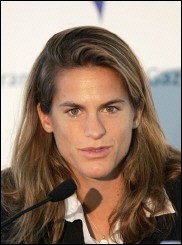
Bracken's sister


Hurray! At last we have found a long lost sister of Nathan Bracken. Shocked? Surprise, surprise - she is a bigger celeb than her brother. Nathan would be happy that Amelie Mauresmo (God knows how she landed in France) is doing rather well in tennis of late.
Look at these pics for the similarities.

CT Awakes: Mind of the metronome

I had the good fortune of being at Mohali stadium for the 1st ICCCT semi final on the 1st of November. New Zealand were gasping for breath during that knockout spell from Lee and Mcgrath after the breather. Between his overs Glenn McGrath was guarding the boundary near our stand. In one of the overs Glenn produced an uncharacteristic ill-directed short ball that allowed the batsman to score a couple behind square leg. He bowled another guided missile to bring that over to a close.


On another day and in front of television, I would have to watch a couple of hastily aired ad spots in the break thereafter. This time I had the luxury of watching Glenn collect his cap from the umpire and amble back towards us, his fielding position, with that well-known shake of the head, grimace firmly in place on chiselled countenance. One look at him and a new entrant to the stadium would conclude that this bowler just went for more than 20. A wave of the hand replicated a pull shot and another shake of the head followed as he finally put on his cap.

Those two 'easy' runs conceded off the fifth ball were killing him. 'How could you bowl such rubbish?' - he seemed to rebuke himself as Lee got ready for another blast at the lower middle order of their arch rivals. This, in the midst of a MoM clinching effort of 10-2-22-3.


cricinfo reports on McGrath's progress since his return:

He said he has "put a little piece of the puzzle back together" in each game he has played since returning from a long lay-off to be with his sick wife. "It's feeling pretty good at the moment, and I was happy with [the semi-final]," he said. "There were a few little errors I can still improve, but it's looking pretty good. If I keep doing that, there's a few more games until the Ashes and I shouldn't be too far off 100%."


Therefore, while all his fast bowling peers are well into their 2nd and 3rd years of retirement, Glenn McGrath is getting it just right ahead of his last Ashes. Yet another batch of English batsmen visiting Down Under may be waking up in the middle of the night.

Friday, November 03, 2006

CT Awakes: Mark Boucher opens up South African options

Little over a year ago Mark Boucher was struggling for his place in the South African side. His wicketkeeping was only a hazy reflection of the sprightly young man from that glorious international debut season of 1997-98. Most of all, his combative batting had lost some of its sheen in that period leading up to the Australia vs. ICC XI in October 2005.
Boucher's selection in the ICC XI raised most eyebrows, including the pair looking into the monitor while keying in this post. Upon hindsight even Boucher will agree that a premature end to a promising career - he is only 28 - was not out of sight at that point of time as the South African selectors explored other options like AB deVilliers as an alternate keeper batsman.

The last year or so has been especially fulfilling for Boucher the batsman in that context. Since the much-criticised Aus-v-ICCXI affair in October last year he has upped his Test batting even though the opposition has been some of the toughest (6 tests versus Australia in either land and two against Sri Lanka in their backyard). Moreover his one day scores have started flowering like never before. Let's have a look at this statistical breakup of his fall and rise as a batsman:

Mark Boucher batting stats (upto Oct 2006)

Tests

Avg, career: 30.10
Avg, Nov 2003 to Oct 2005: 26.85
Avg, Nov 2005 to Oct 2006: 29.36

ODIs

Avg, career: 27.93
Avg, Nov 2003 to Oct 2005: 27.45
Avg, Nov 2005 to Oct 2006: 44.62
The clincher of an innings he played against Pakistan coming in at 36/4 in the league match at Mohali the other day was another confirmation of his capacity to fill up a lower middle order position in the South African ODI line up. That would hand his team a useful leverage in the form of flexibility to pick a few slow bowlers without leaving out any of their potent fast men.
Ahead of a world cup which is likely to test their adaptability to the fullest, 'Boucher on song' may well be some much-needed soothing music for the selectors.

Thursday, October 19, 2006

Mera naam hai Bond

The Hindi movie world sure has a soft spot for genuine fast bowlers. Brett Lee is a big favourite with the Indian film Industry (led by Amitabh Bachchan) and so is his old competitor at 100 mph stakes, Shoaib Akhtar.

Methinks Shane Bond's in the same league and, being creakier in fitness than either, may need an alternative career earlier than both. Why he even has a couple of advantages in the tinsel world over his two rivals: he is an ex-policeman like the inimitable Hindi movie star Raaj Kumar, and - surely I did not need to say this - the name is Bond!

Is there nobody in that New Zealand side to drill some common sense into him? Now I get the real background of their unglamorous tag. What's he doing in this country if not knocking at Mumbai's big production houses exploring on-screen assignments for his future career?
Perhaps it is a case of once bitten twice shy; Bond may be fearing more injuries in his new career from those high-risk 'main tera khoon pi jaunga' action scenes. People like Subhash Ghai could come forward and help alleviate his dillemma. The New Zealand paceman could change his mind with a few words of assurance that he will get doubles for his thrills and the dodgy back and leg face no real threat from this new career - other than (ambush clause) the mandatory dances choreographed by Ganesh Acharya for chartbusting Himesh tunes.

CT Awakes: Lara's farewell gift

Some visionary and inspired steps must be taken and specific empowerment made by the concerned management – including the cricket board, the selectors, the coach and the skipper – in their respective areas of administration for players to start responding with improved attitudes and collective success as the West Indians are doing these days. While the others deserve no less a share of the praise, in this post I wish to concentrate on the person who enacts the last mentioned management role on that list. Brian Charles Lara, the West Indian captain.


At some point of time all of us have secretly or publicly, mildly or strongly held Brian Charles Lara to be a reason for a seemingly perennial West Indian decline. Lara was perceived to be 'selfish' and 'a prime cause of disharmony' within the team even in their better days during mid 90's. A few of the stories of hot-headedness and ego hassles were perhaps true while most of the nasty ones were popularised fables.


The early reputation of Lara continued to haunt him into the second half of his career when he recovered from an impeding mid-career leg injury and decided to concentrate more on being at his sincerest in Test matches. And never did he suffer more from this popular misinterpretation of his habitual blunt talking as high-handedness and disinterest than in his 2nd tenure as captain.


Even after the blatant show of indifference from his other teammates in crunch situations it was pretty much Lara the 'flop' captain who always faced the criticism. And like a true captain he kept taking it without looking in other directions. And through all that negative feedback and advancing age he kept popping in a few unknown magic pills that helped him remain the same positive player and instinctively shrewd captain.


Limited resources never limited Lara's vision of where he wanted to lead the team to. Saddled with the most suspect batting order in international cricket since time immemorial, he is still not averse to risking his reputation and credibility in following his gut instincts. His gamble of playing himself at no. 9 at Kuala Lumpur to let his players get some match practice in an inconequential game again showed that quality of his.


I will now bring up the one point where all criticism of Lara invariably starts: his integrity, his oneness with the West Indian cause. In walking off the square before umpires moved to rule him 'out' as also in separating himself from the grind of international cricket temporarily or permanently for mutual benefits, this man has listened to his heart on most occasions and been misunderstood at times in the process.

While his petulant responses to media glare were not the proudest moments of his earlier career, he cannot be faulted now if he starts expecting generous appreciation for his commitment and endurance, virtues that his nature on and off the field hardly seemed compatible with.


A year back he had publicly declared his retirement from ODI's to prolong his Test career and yet, he has now opted to come back from that retirement for a limited period after he was recently honoured with the West Indian Test captaincy for a third time. He did that not to pocket some career-slog-over earnings before retiring for good. As the leader he felt obliged to be part of the process that aimed at the West Indies team doing well in the upcoming home World Cup.


Are there still people in his homeland and across the cricket playing world that feel Mr. Brian Charles Lara did not put in enough efforts for contributing to the sport that gave him everything? Perhaps it is time that the others, who I believe are a growing majority, simply ask them to shut up and revel in the slow and steady transformation that their old champion is leaving back for his still-admired team. It was obvious from Sarwan's display of leaqdership skills in today's match that Lara has seen a capable successor in Sarwan and is quietly grooming him to take over the mantle smoothly.


Even with its many flaws, Lara's team appears to be finally congealing into a unit that is prepared to kill to win. They look destined to traverse deep into the business end of CT and WC. Irrespective of a West Indian win in either tournament, Lara deserves a healthy round of applause for his immeasurable contribution towards resurrection of the West Indies as a one day side that manages to arouse that feeling in us once again.

The West Indian Test side will certainly not regain even part of its former glory during his playing days but one can expect the Prince to be around in some other capacity in later years to guide the boys towards that vision.

The CT does not sleep anymore

Jerome Taylor, the most promising young fast bowler outside of the 2 Ashes playing nations, goes back a few steps from the crease to bowl his last delivery. Australia need 12 runs to win off one delivery against West Indies, and the young-man-with-a-glacier-inside realised he just needed to ensure this one to be the last for the evening.

He achieves that goal by bowling Trevor Chappellesque slow medium off a few steps. [I ask Greg about it and he confessed that Taylor's delivery has bounced infinitely higher than Trevor's.] In leading his team to an improbable win Taylor makes a statement as poignant as that last delivery is unexpected of any genuine quick bowler, least of all a Caribbean one. Essentially that he would rather be part of a painstakingly improving team of proud contributors than get sucked into the familiar "image trap" that lies ever so near his newly achieved place in a game that still worships its fast bowlers and reserves instant stardom for them. [No prizes for guessing who I am referring to..]
Announcement:
The ICC Champions' Trophy race is suddenly getting very hot as an expected consequence of the first 4 group league matches producing 3 upsets (2 mini and one major). There can be only one better way to get those disgruntled cricket lovers around the globe glued back to their TV sets than a cricket tournament that throws up upsets: a cricket tournament yielding closely fought medium scoring upsets. Precisely the description
befitting yesternight's
Pak chase and today's Windian heroics..
I have made 2 posts on CT matches in the past couple of days: The Eng-v-Ind and SL-v-Pak matches. Instead of delaying the inevitable I hereby declare this current post on the Aus-WI thriller as a kick-off post on Pavilion View to launch the "CT Awakes" series that will cover ICC Champions' Trophy 2006 events.


Did I mention the Aus-v-WI result to be an upset? To be honest I felt sort of odd saying that. I checked up on a few statistics and they all supported that odd feeling. Inspite of their continued batting fragility this West Indian lot is arguably the most competitive side we have seen from those islands since the turn of the millenium. That was not good enough, I reckon. Okay then: They are amongst the most competitive teams today, period.

The Australians are having their own one day batting woes of late as are the CT hosts, India. They were the two best batting sides in ODI's even a few months back but their batting form has dipped significantly since they began running into the West Indians every now and then.

It would be both unfair and foolish to ascribe that likeness in batting decline of the two higher-ranked, smoothly chugging teams after facing Lara's men to coincidence and / or slow pitches. If you so wish, you are allowed to dismiss India's (remaining) claims to formidability on grounds of inconsistency. But the all-conquering cricketers from Australia give you no such leeway and a good show against them must be a reflection of cricketing ability. Ask Vangipurappu Venkata Sai Laxman. We can take another example.
Dwayne Bravo was an unknown threat when Yuvraj Singh and his teammates struggled against the Trinidadian's slower yorkers in the Caribbean a few months back. But after Kuala Lumpur and Brabourne you realise that for all the support staff at their disposal a middle order like Australia's is yet to find an answer to Bravo and his mates on slow-low pitches. With a World-Cup-ful of slow and low tracks around the corner, that translates to a longer duration of 'slower' rule by Caribbean medium pacers than most reckoned.
Let us assess the West Indians in light of their recent performances against the Killer Kangaroos.

Since they crashed to 0-4 in the midst of a 7-match ODI series back home immediately after the 2003 World Cup, the West Indians have been regrouping themselves and proving to be a constant thorn in the flesh of the world's most awe-inspiring ODI team.
The Calypso boyz won the last three matches of that 2003 series on the trot, and since then they have returned a respectable won-2-lost-4-noresult-1 scoreline playing against the Aussies over 3 separate tournaments in 3 countries. That summarises to 5-4-1 (Win-Loss-NoResult) in their last 10 ODI's versus Ponting's men since 25th May 2003 till date.

Corresponding figures (Win-Loss-NoResult) for other major teams in their last 10 games against the Australians:

South Africa: 5-5-0
England: 2-7-1
India: 1-7-2
New Zealand: 2-8-0
Pakistan: 1-8-1
Sri Lanka: 3-7-0

Surprise, surprise! So the 'struggling' West Indians have won as many games against Australia in their last 10 encounters as the 3 sub-continent majors put together and compare rather favourably with the famously Aussie-baiting South Africans.

It is high time that credit goes where it is long overdue. That Jerome Taylor last delivery was an outcome of a process of rebuilding techniques, attitudes and minds. The next post of 'CT Awakes' series shall be dealing with a man integral to that rebuilding process.

Wednesday, October 18, 2006

And then it strikes him

Let us go 20 years down the line. It is year 2026. You just got introduced to FutureFan, an average new age cricket lover of the time in a cricket playing country outside the subcontinent. You are pushed by this young fella that jabbers incessantly on cricket. You want to have some fun and test the cricket acumen of this cocky youngster.
You take leave for a minute and come back with a printout of the scorecard of a Pak-v-SL ICCCT match played on the 17th of October 2006. You have erased a lot of information from it, including team names, player names, championship and year of contest. Then you hand it over to FutureFan and ask him to identify the international team that won this contest. He needs to get it right at one go, without any external help. In all likelihood he will think hard on the tampered scorecard from a not-so-famous oldie and reply in the negative.

You share your first cryptic clue at this point: Key bowlers of the winning team were sent back 2 days ahead of this match due to some reasons while their formidable opponents came into this match in prime form, with a 10 match winning streak under the belt. There's a steep chance that your examinee will start thinking of a few teams by this time. He would not take a name at this point though.

You supply the 2nd clue: The captain of this team, who was also their best batsman, was prevented from taking part of the tournament due to some other reasons and there was a major controversy just ahead of this tournament even regarding the new captain. FutureFan will start thinking on those lines but drama outside the cricket pitch was never this guy's cup of tea. He is still blank.

It's time for the 3rd and last clue: This particular match happened at a time when the team was in the midst of a seemingly endless lookout for decent openers and decent catchers.

Furrow-browed FutureFan now stares at you with indignation. 'I can't get you old man. You say that coming into this match the team was plagued with off-field problems, had no openers or catchers worth their salt, were hamstrung in bowling and impaired in batting.....are we bloody talking about the winning team or what? And how the hell do you expect me to identify the team from that set of crap?'

You just smile in reply. And then, then it strikes him. FutureFan enquires sheepishly: 'It must be Pakistan, wasn't it?'

Tuesday, October 17, 2006

CK

We love Sunny Gavaskar. If only he could weed out a few yawning draws from his resume....


We love everything about Sachin and Kapil. Wait wait, but 'everything' includes captaincy....


Everyone misses Vishy's class and beauty. No one misses his fielding though.


We love Dada's aggression in driving spinners and rival skippers to madness but we may not reach out for our wallets if asked to bet for his work ethic.


We love Dravid's work ethic and determination but is he calling the shots when it matters?


Through a brief but informative piece I recently came to learn more about the only - I repeat ONLY - international cricketer in the subcontinent's cricketing history who combined typical cricketing abilities of an Asian cricketer with the no-quarters-given-or-taken work ethic of an European, an elusive combination many foreign coaches in these parts are breaking their heads to achieve. Read on.


He's our first and foremost one. Colonel Cottari Kanakaiya Nayudu, CK in short.


And if this was not enough, his captaincy - in the colonial days when English folk were 'mai baap' - could make even Sourav Ganguly's stuff look like mother care. No wonder India placed a strong claim for Test status mainly through his efforts.


How I miss everything about him.

Update (31-Aug-10): This must be the most long delayed update I have ever written to a blogpost. Could not help it. I was reading a special Amit Varma post @ India Uncut on Indian chess and its cult figure Vishwanathan Anand, 'The man with the Maruti 800'. The last paragraph of that piece took me back to CK Nayudu.

Who knows, one of them* may even win the World Championship someday. But it won’t be as big a deal as this. Anand is special.
* modern Indian chess players whose chess upbringing, as per Amit, has a much narrower gap with westerners compared to the hopeless scenario at the time when Anand learnt his chess

Earlier in this post I had brought up some chinks in the legends of some other great Indian cricketers in order to elevate CK's standing. But somehow I still could not precisely bring out what CK actually meant to Indian cricket in my eyes.

Amit gives me a chance to make up for that failing nearly 4 years after writing the post. I can now refer to his post and state with clarity what I set out to say in that post:

Sachin, Sunny, Kapil and the other cricketing greats named earlier in this post were world champs worth their weight in gold. But then all of them learnt their 'chess' availing facilities similar to the modern Indian chess players. CK was 'Anand'.

Tail piece: The last analogy may be debated. "CK was Dibyendu Baruah at most - Lala was Anand" and so on!! I close my argument here, others are free to continue.

Monday, October 16, 2006

Dirty Harry can't find his sixth bullet

This article made for nice reading. Ian Chappell finds interesting similarities of the top six men that matter in each of the major Champions' Trophy sides with the six bullets loaded in chambers of a 'six shooter' revolver. I thought the old fella's pretty much on the bull's eye or thereabouts. Except for the part on Indian bowling and batting, that is.

Chappelli has this to say about Indian bowling:
"...the West Indies, South Africa, England and India all fall a bit short in bowling class but the hosts can raise themselves into the first group if Pathan is firing on all cylinders."

The Indian bowling department is shaping up coolly and admirably for the battle on hand and the war coming up. Over the last three or four series we have seen two of Agarkar, Harbhajan and Munaf taking turns at the 'the miser and the mauler' duties in all matches irrespective of Pathan's bowling form which still remains important to Indian fortunes as Chappell senior underlines repeatedly in that piece.

However the following part of his observations reads more like high hope than any immediate possibility with every passing day:
"India with Virender Sehwag in form and opening would be formidable."
Barely six months after making the world sit up to a booming cresendo of consecutive batting explosions last season India are suddenly in desperate want of another century maker to support Tendulkar in the batting department. All three potential candidates - Dravid, Yuvraj, and Sehwag - are inexplicably looking quite a distance from that vacant role at present. For confirmation of this willow worry we only need to look at Indian batting scorecards for the last 10 ODI's.

Sehwag, in particular, is a major cause of shivers. Never an owner of a brilliant defence or deft footwork on the crease, today he appears to have lost a chunk of even the modest lot of the basics that he started off with. He looks determined that he does not want anything in the name of a basic batting technique to come in his way. He would be well advised by his supporters inside the camp to look where that 'way' ends.
They can perhaps persuade Sehwag to re-assess all the aspects of his game that got him here - at this apex level - in the first place. Too much of his present batting performances depends upon the bowling errors he is allowed and he looks a fidgety batsman whenever top bowlers bowl to a plan against him. As far as my memory goes, an attacking game was never EVERYTHING that Virender Sehwag had in 2001 when he scored his debut Test century in South Africa.
India have a trigger-happy wicketkeeper, a serviceable all rounder (Pathan), the two war-painted bowlers and one bazooka of a batsman. That fills up five chambers. Rival gunmen are already firing shots in our backyard. The English ones nearly broke into the building today. India's missing bullet rolled under the cot quite a long while back. Someone please retrieve it NOW....

Thursday, October 12, 2006

The smaller but deeper worries

There was a time when 600 plus runs in an innings were a norm in Indian domestic first class matches. As much as a reflection on the pitches, it was also an indication of a cultural imbalance: India produced far more quality batsmen than quality bowlers. The just concluded 2006 Irani trophy match missed the services of many top cricketers in the country, all of whom are busy preparing for upcoming Champions' trophy.

Consequently the UP vs. ROI clash literally ended up as a contest of the reserves. The outcome, specifically the 2½ day finish, hints at a specific area of concern regarding the future of domestic long duration games: that old imbalance is showing signs of getting reversed, and an equilibrium is not necessarily the likely destination of that reversal.

The ideal state to achieve would be a balance between bat and ball. At present though while the bowling stock is improving since the bygone years, the batting reserves are getting pitifully thin on quality. Pratyush Khaitan highlights this area in his Irani trophy review
here. The trend is supported by the dwindling fortunes of our senior squad in Test matches over last couple of years. If the improvement in bowling means we can think of going into a Test match armed with the confidence of taking the 20 opposition wickets, we will still need runs on the board to compete.

Well, we always knew this vacuum as a distinct possibility for the international side once those 3 greats born within a year of each other and another barely 2 years younger than them sealed all the available middle order slots for better part of a decade with the BCCI going to sleep on the back of brilliant performances from the famous four with no proper plan of succession in place. [I know what you are thinking: Had Sourav Ganguly received better treatment and a decent exit route, I would have believed that Ganguly's ouster was indeed part of a succession plan.] Players like them are difficult to replace, and it is understandable that the process will take some time.

But a similar void at the first class level is a far bigger worry. Who do we replace Sachin or Dravid with when it is time to move on? For that matter, are we developing enough ready substitutes for even the fledgling Yuvis, Kaifs or Rainas in the event of their non-success at the Test level? Hope we are headed the Australian way (who bounced back from a temporary mid-80's trough by identifying the need to plan, develop and select with a vision) rather than the West Indian one (still smarting from loss of great players thru the 80's and 90's, with no plan on the horizon as yet).

It must be said that Greg Chappell the national coach can take some credit for the BCCI waking up to a need to have good bowlers for producing consistent results. It remains to be seen if Greg takes the same pains for the willow wielders of the future.

P.S. I just heard Greg's closest ex-competitor for the post Mohinder Amarnath howling in laughter after reading that last line and calling me a joker. Fair enough; try staying sober after reading
this scorecard from a Ranji final he played in nearly 25 years back - lack of runs was hardly the problem there. Those were the days folks...

Monday, October 09, 2006

A thought on Mufambisi

There's a saying in some language: every person has a replica in this world. You may have heard of that. There's another saying that you never heard of: even though you love a game, some matches can be so bad that you fail to live through them. I do not know the speaker of the first quote but you know who said the second.
The first time I saw Zimbabwe opener Tafadzwa Mufambisi was in the 6th over of today's non-match. He played a ball from Ian Bradshaw in a familiar fashion.
I was already expecting the match to be one-sided (just like you, and those fellows chattering behind your back, and the person who got a verbal pasting from you last week, and your grandma). The words 'precious' and 'few' often go hand in hand and today as a cricket viewer I was feeling like a shining million year old piece of carbon by the time 6th over started. I know you understand how rare a feeling that must be in this cricket mad country...
With the best interests of cricket at heart I tried a novel way to internally generate interest in the contest; an important ICC event like this should not lose valuable audience this early in the tournament. "I'll try handing out a quick rating on the form and quality of this guy taking strike from the first shot I see," I thought. After the shot: "....I think he will be good attacking player with decisive footwork, while his defensive technique needs work."
While West Indian bowler Ian Bradshaw returned back to his mark, this Zim opener's game (that is, whatever I boast to have seen of it in all of one ball) continued to half-remind me of another young player. However I could not pinpoint who that was. Both showed decisive and fluent forward footwork and natural stroking ability with the bat while the defence needed a few more layers. So which player was young Mufambisi a replica of?
Fortunately I did not have to rack my brains for too long - the answer came in the next (or was it next-to-next) ball when Mufambisi cut Bradshaw to point and an alert fielder swooped down on it in a flash. Dwayne Bravo it was indeed.
Unfortunately that was the end of my new one-ball game of replica hunting; I was forced to switch channels soon with a heavy heart as proceedings became increasingly insufferable.

Saturday, October 07, 2006

"It won't leave much for the highlights film"

Love the way John Stern sums up a growing need to recreate fast bowling magic.

Going through this list of interesting cricket facts on 123India cricket, the one I loved the most was:

Kapil Dev`s only break of one Test in his 131 Test career came after 65 Tests.


So the poor old all-rounder was only trying to bring about a little symmetry in a long career during his unproductive twilight years. Tch, tch....on hindsight it was unjust on my part (and by a few likewise dirty minded folks I know) to misread that act as a hankering for Richard Hadlee's world record 431 wicket tally. No fire in hell will be too bad for us unduly heartbroken admirers of the man....

But thanks to Warne and Murali, these days we find it hard to digest that such a miniscule record actually existed as recently as 1994!

Friday, October 06, 2006

Sanjay Bangar

Some cricketers have all the luck.

They get extra chances, extra facilities, extra media attention, extra fan following and the utterly forgettable resultant - extra sponsorship deals.

You can bet that dour and gritty ex-India player and Railways all-rounder Sanjay Bangar never got to play those extraaa shots. He is your regular no-nonsense bits-and-pieces guy, born to do everyday jobs of far less national importance than making people flock to stadia just to watch him play.

So what kind of jobs do the Bangars do? Leading an unfancied Railways side to Ranji trophy triumph, for example. Or setting little big examples of solidarity that help alleviate perennial woes of his railway mates making do with a non-existent support system. And helping bind his bunch of men-on-wheels together to make this team perform wondrously better than the sum of its parts.

Unfortunately the options of extra chances, extra facilities and extra attention fly extra quick out through of the window when a blue collar guy enters the scene. That brings us to another question: what does a Bangar get back for his contributions? Let us explore.

A Test batting average of 47.85 at home. Hmm, that is a steady start. That figure is 18 points more than his overall Test average, something he can mention to his grandchildren with a 'been there done that' nod. Pity Bangar the bowler could never back it up and remained wicketless in his six home Tests, or he could be a rather handy all-round horse for the Indian course. Let’s see what more we have in the Bangar baggage of collections.

OMG, he is the guy with the most unforgettable ‘only fifty-plus Test score on foreign soil’ on earth! Wow, wonder how this most temporary of openers had the audacity to partner Dravid in exorcising the resident evil ‘genie of away losses’ out of its permanent abode, the Team India bottle, on that crucial first day of the 2002 Headingley Test.

It seems he did have some luck in making himself a name.

“Aw c’mon, look at the stinking ODI stats of this all-rounder…”

Truth hits you hard and snaps you back to reality with a batting avg of 13.84 and bowling avg of 54.85. That batting average is a full two points less than Agarkar’s! I’m afraid the fairytale has ended and we have no more knots to unravel inside Bangar's backpack…he will now have to walk away into the horizon clasping his pedestrian record close to heart. Sadly the bag is all empty now. But at least Bangar has been guaranteed of some applause along his exit route after showing off those extraa bits of his.

Hold on a second, what of that only ODI fifty of his in 15 matches? Scoring 57 off 41 balls at five down with 96-to-win in a fifty-over–match enroute an overhaul of West Indies ‘ 325 in India was surely no joke. There there, even his only 50-plus knock in ODI’s threw a punch worth remembering. Dravid was again the partner watching from the other end.

Given that Sanjay Bangar played so few matches for India and did not exactly set the stage on fire in those, it is unusual that we remember almost every notable performance he put up in India colours. Some people have all the luck indeed. Perhaps they deserve no less.

A few extraa claps for Sanjay Bangar please.

Thursday, October 05, 2006

The Psychos

"Who writes your scripts?" asked Graham Gooch to Ian Botham once. Well, who writes theirs?

Update: I bet you thought you would not see greater drama than that. Ha ha - now watch the sequel!

These are moments when you feel Pakistan cricket administration is indeed a virtual world inside the 'Matrix' as against the real world where all the cricket is being played, watched and loved. From the same perspective this latest episode was its 'Reloaded' (Younis) and 'Revolutions' (Youhana) sequels rolled in one.
Apologies for that misnomer of a post title.

How do we keep THEM?

Amidst stars old and new, shining and falling, promising and delivering, the performance of wicketkeepers of each of the three “India”s participating in this year’s Challengers’ trophy provoked a thought . How do we keep them?

Parthiv Patel first. We have seen his gloved journey from youthful brilliance to loss of lustre to losing the entire plot as a specialist keeper. All through that though he has showed impressive improvement in every outing with the bat. Aged 16, he saved a crucial away Test match on debut. Then on he kept building on his nudges and pushes to emerge as a dependable lower middle order bat who could score fluently either side of the wicket and, importantly, would not cower in adverse situations. He shone with the bat in his two Challenger matches this year (just as he did last year). His latest performances could have helped him pose serious threat for almost any keeper playing in the national side. But unfortunately it isn’t ‘any keeper’ that he is up against.

Parthiv’s continued rotten form with the gloves in 2004 brought us to Dinesh Karthik. In his 1st ODI he effected a fantastic airborne stumping [while falling away from the stumps] to tilt a low scoring close match in favour of India and thereafter most things that he and the other keepers in India (Dhoni included) have done could only cement the belief that Dinesh is arguably the best amongst Indian glovemen who can bat decently. Like Parthiv he does not cower in pressure situations either and demonstrated his qualities in front of the stumps in the 2005 Test series against Pakistan. And like Parthiv he’s only 21. Dinesh shone with the bat too in this Challenger trophy. But just like his predecessor (again) his efforts are also certain to go unrewarded.

When Dinesh Karthik got relieved from national duties he did not need to lose form with either bat or glove to get replaced by Mahendra Singh Dhoni in a one day squad. That would be true for any wicketkeeper in the history of one day internationals barring Adam Gilchrist. Dhoni proved just that point during the just-concluded 2006 Challenger series. Essentially Indian selectors are left with no choice but to refute the claims of a good keeper-batsman, Dinesh, and a decent batsman-keeper, Parthiv, for both ODI and Test selections because of the irresistible package that is MSD. And that may be a bit of a tragedy in the making.

There is little doubt in my mind that sooner or later Dhoni is going to become a full fledged middle order batsman in Tests and maybe even in the ODI’s at a more advanced age. In other words Dhoni will do a Dravid when he reaches thirty. [He should, if you ask me.] The role change may come due to a change in his batting temperament, or due to declining glovework in the face of added batting responsibity with increasing seniority, or both. That will open up a possibility of Karthik or Patel - even both - getting national call-up(s) for the specialist keeper’s role in Tests and / or one dayers half a decade hence. But can they keep themselves in the hunt for that long a period? Are they single minded enough to survive the guaranteed snub of the intervening years?

Indian cricket is notorious for letting young and promising cricketers lose heart and focus after their first brushes with failure. Out of a batch of 5 or 6 promising young cricketers inducted into the national cricket team in the mid 80’s only Azharuddin made it into the 90’s. It was the same with another batch of rookies in early 90’s of which only one Sourav Ganguly had the heart and the luck to make a grand comeback half a decade later.

This is one of those areas where the national selectors need to step in with a vision and decisive action plan for the future, a future that does not end with their respective tenures. They need to share that vision with the zonal cricket bodies and selection committees. They need to talk to the young aspirants and explain to them the vital role planned for them in the future provided they stay focussed.
A Colonel has been posted on the warfront and he knows that his job is far beyond everyday paperwork.
Keep the keepers focussed, Colonel. We will need them.

Monday, October 02, 2006

The men with a knockout punch

When the going gets tough the tough get going, they say. What can be tougher in one day cricket than a knockout match? The next knockout match perhaps.....and so on till we have the final. George Binoy of cricinfo lists some stats here that can help separate men from boys in ODI's.
It's a pity that the Test matches do not have knockouts; spanning over five days, those would have been the sternest tests of sporting character one can think of.